In this edition of Capitol Connection, we highlight the latest federal policy updates affecting Autistic individuals and their families, including developments on education, disability rights, research, and public safety. We encourage you to stay engaged and visit the Autism Society of America’s Action Center to contact your Members of Congress and advocate for policies that support Autistic individuals and their families.
Congressional Updates
ASA Congressional Event Sept. 1
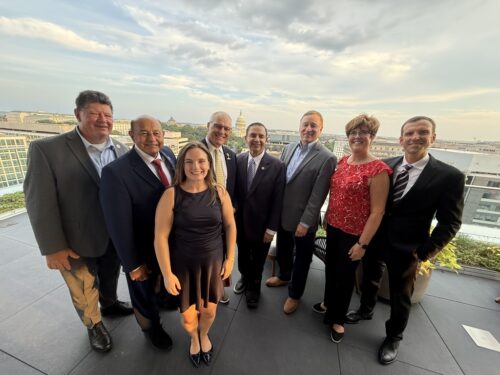
The Autism Society of America hosted a Congressional Reception on September 1, bringing together Members of Congress, congressional staff, advocates, community leaders, and partners committed to advancing policies that improve the lives of autistic individuals and their families.
Co-Chair of the Autism Bipartisan Congressional Caucus, Representative Henry Cuellar (D-TX), joined Representatives Lou Correa (D-CA) and Pete Stauber (R-MN) in offering remarks during the evening.
The Autism Society thanks our event sponsors for their support: Aflac, American Property Casualty Insurance Association, American Property Owners Alliance, Council of Insurance Agents & Brokers, Liberty Mutual, National Association of Realtors, and Rusbuldt & Associates
Appropriations Update
Congress has yet to complete the Fiscal Year 2027 appropriations process. The House has passed several of the 12 appropriations bills, while the Senate has not yet advanced its bills amid disagreements over overall spending levels and member attendance.
Before the August recess, the Senate passed a Continuing Resolution (CR) to keep the federal government funded through December 11. The CR maintains funding at levels aligned with the previous fiscal year and includes a provision temporarily blocking a proposed Office of Management and Budget (OMB) rule that would change the federal grant-making process and give political appointees greater review authority over certain federal grants.
Following the August recess, the House passed the Continuing Resolution by a vote of 370–48, after the Senate had previously approved it 90–6. President Trump subsequently signed the measure into law.
The House has shortened its September session and will return home after this week, while the Senate is scheduled to return next week. With the November elections approaching, it remains unclear when Congress will resume work on the remaining Fiscal Year 2027 appropriations bills.
Legislation to Prohibit Department of Education Moves
On July 30, the Senate Health, Education, Labor, and Pensions (HELP) Committee held an education markup and advanced several pieces of legislation supported by the Autism Society of America, including the RISE Act, the READ Act, and bipartisan legislation to prohibit the transfer of several offices within the U.S. Department of Education (ED).
The bipartisan agreement, led by Senators Tim Kaine (D-VA), Lisa Murkowski (R-AK), and Susan Collins (R-ME), would prohibit the Office of Special Education and Rehabilitative Services (OSERS) from being moved out of the Department of Education. It would also prohibit the transfer of several other offices, including the Office of Elementary and Secondary Education (OESE). Notably, the agreement does not include the Office for Civil Rights (OCR).
The Autism Society of America, along with other allied organizations, continues to call for OCR to be included in the legislation. At the same time, the Autism Society supports this bipartisan agreement as an important step toward maintaining the Department of Education’s critical functions within the agency. ASA remains concerned that proposed changes to the Department of Education are being undertaken without sufficient consideration of their potential impact on students with disabilities and the services they rely on.
Following the Senate HELP Committee markup, the House introduced legislation containing the same bipartisan text agreed to by the Senate committee. Representatives Bobby Scott (D-VA), John Mannion (D-NY), and Brian Fitzpatrick (R-PA) are leading the House effort. See Press Release here. The Autism Society of America is continuing to advocate for Congress to advance and pass this bipartisan agreement before the end of the legislative session.
Administration Updates
Executive Order on Vaccines
On August 10, the President signed an executive order directing changes to federal childhood vaccine recommendations, including a focus on vaccines for 11 diseases rather than the broader set covered by the existing schedule. The order also directs HHS to study vaccine timing and sequencing, including the possibility of separating the measles, mumps, and rubella (MMR) vaccine into three individual vaccines.
During the signing ceremony, the Administration made statements suggesting that vaccines may be responsible for the increase in Autism diagnoses. However, decades of rigorous scientific research involving millions of people have found no causal link between vaccines and Autism, including the MMR vaccine.
The Autism Society supports Autistic individuals, parents, and caregivers having a voice in healthcare decisions and access to accurate, evidence-based information and trusted healthcare providers. Parental choice and evidence-based science can and should work together.
The Autism Society also supports continued research into Autism, including its causes, biology, environmental factors, and vaccine safety. The increase in Autism diagnoses does not, by itself, establish what is driving that increase. Autism has no single known cause, and research continues to examine the complex roles that genetics, biology, development, and environmental factors may play.
Read our statement and Q&A resource here.
HHS Wandering Alert
The U.S. Department of Health and Human Services (HHS) announced the development of the first-ever National Autism Missing and Endangered Person Alert initiative. Led by HHS in partnership with the U.S. Department of Justice (DOJ) and the Federal Emergency Management Agency (FEMA), the initiative will strengthen coordination among law enforcement, first responders, emergency management agencies, and community partners to improve responses when autistic individuals are reported missing.
Rather than creating a new national alert system, the initiative will promote more consistent use of the existing Missing and Endangered Persons (MEP) alert category through FEMA’s Integrated Public Alert and Warning System (IPAWS) for qualifying incidents. Federal agencies will develop national guidance, best practices, templates, and training to help state, tribal, territorial, and local authorities respond to autistic individuals who wander or elope and face imminent risk.
The Autism Society is encouraged by this initiative and the recognition of wandering and elopement as a critical safety issue for the Autism community. Our affiliates have long worked with communities and policymakers on these issues at the state and local levels. We look forward to working with federal, state, and local partners to support implementation and ensure jurisdictions have the resources and guidance needed to strengthen their emergency response systems.
CMS ABA Toolkit
On August 4, Centers for Medicare & Medicaid Services (CMS) released the State Medicaid and Children’s Health Insurance Program (CHIP) Applied Behavior Analysis (ABA) Toolkit. The resource is intended to help state Medicaid and CHIP agencies address concerns about rising expenditures, inconsistent clinical practices, and fraud in autism services.
The toolkit is nonbinding guidance, meaning it does not change federal Medicaid eligibility or coverage requirements. Any changes to coverage, authorization, or documentation requirements would need to be implemented by individual states.
The Autism Society has concerns about the toolkit’s overall approach, which places significant emphasis on spending and fraud prevention rather than access, quality, and quality of life for Autistic people across the lifespan.
The toolkit includes important recommendations related to individualized, person-centered treatment, stronger provider oversight, and caregiver involvement. However, some of the proposed safeguards could create additional barriers to care. Key concerns include increased authorization and documentation requirements, delays caused by lengthy diagnostic evaluation of wait times, and limited attention to the needs of Autistic adults.
The Autism Society will continue to monitor implementation of the toolkit and advocate for policies that protect access to high-quality, person-centered services for Autistic people and their families.
IACC Update
The Interagency Autism Coordinating Committee (IACC) met on August 27 to discuss and vote on its proposed Autism Strategic Plan. The meeting was originally scheduled for July 31 but was postponed after stakeholders raised concerns that they did not have enough time to review and comment on the draft plan.
The Autism Society submitted comments commending the IACC for recognizing that the needs of Autistic people and their families extend across the lifespan and beyond research, including health care, education, housing, employment, mental health, family supports, and quality of life. We also appreciate the plan’s recognition of the diverse experiences and needs of Autistic people, including people with intellectual disability, high support needs, nonspeaking and minimally speaking individuals, people with co-occurring medical conditions, and underserved communities.
At the same time, we are concerned that the plan’s extensive scope could make prioritization and implementation challenging. The plan includes a wide range of priorities, initiatives, federal agencies, data systems, demonstrations, and other efforts that together represent a significant federal undertaking. In our comments, we identified areas we believe should be prioritized to help guide implementation.
With Congress currently providing just over $300 million annually in federal Autism-related funding, prioritization will be critical to ensuring limited resources are directed toward the areas of greatest need and impact.
The Autism Society looks forward to working with the IACC and federal partners on next steps to advance the plan and address the needs of Autistic people and their families.
Texas v. Kennedy Case Update
There has been a significant update in the Texas v. Kennedy case, which challenges federal rules protecting the right of people with disabilities to live in the community.
In June, the Department of Justice’s Office of Legal Counsel issued a memo stating that federal disability laws, including Section 504 and the Americans with Disabilities Act (ADA), do not require community integration. The memo does not change the law, and the Supreme Court’s Olmstead decision and the integration mandate remain in effect.
Following the memo, the Department of Health and Human Services (HHS) changed its position in the Texas v. Kennedy case. On August 31, the Department of Justice, on behalf of HHS, joined five states in asking the court to remove references to community integration from the Section 504 regulations, including the entire integration provision. The request does not affect other parts of the 2024 HHS Section 504 Rule. Importantly, this request does not change Section 504 or the ADA, nor does it change longstanding legal precedent interpreting these laws. Only Congress can change the law.
Disability advocates have raised concerns about this change and its potential impact on the rights of people with disabilities to live and receive services in their communities. The Autism Society will continue to monitor the case and advocate for policies that protect community-based services and the right of Autistic people to live in the community.
Learn more here.
Share:
Related Posts


Featured
Information Series
Updates and News