In this issue of Capitol Connection, we provide updates on the status of federal funding for Fiscal Year 2026, including ongoing efforts to prevent another government shutdown. You’ll also find the latest developments at the Department of Education, emerging Medicaid community engagement requirements, and new resources to support family caregivers and disability advocates as key policies move from Congress to state-level implementation. As these decisions carry significant implications for people with disabilities and their families, we encourage you to stay engaged and visit the Autism Society of America’s Action Center to connect with your Members of Congress on these critical issues.
Disability Policy Seminar
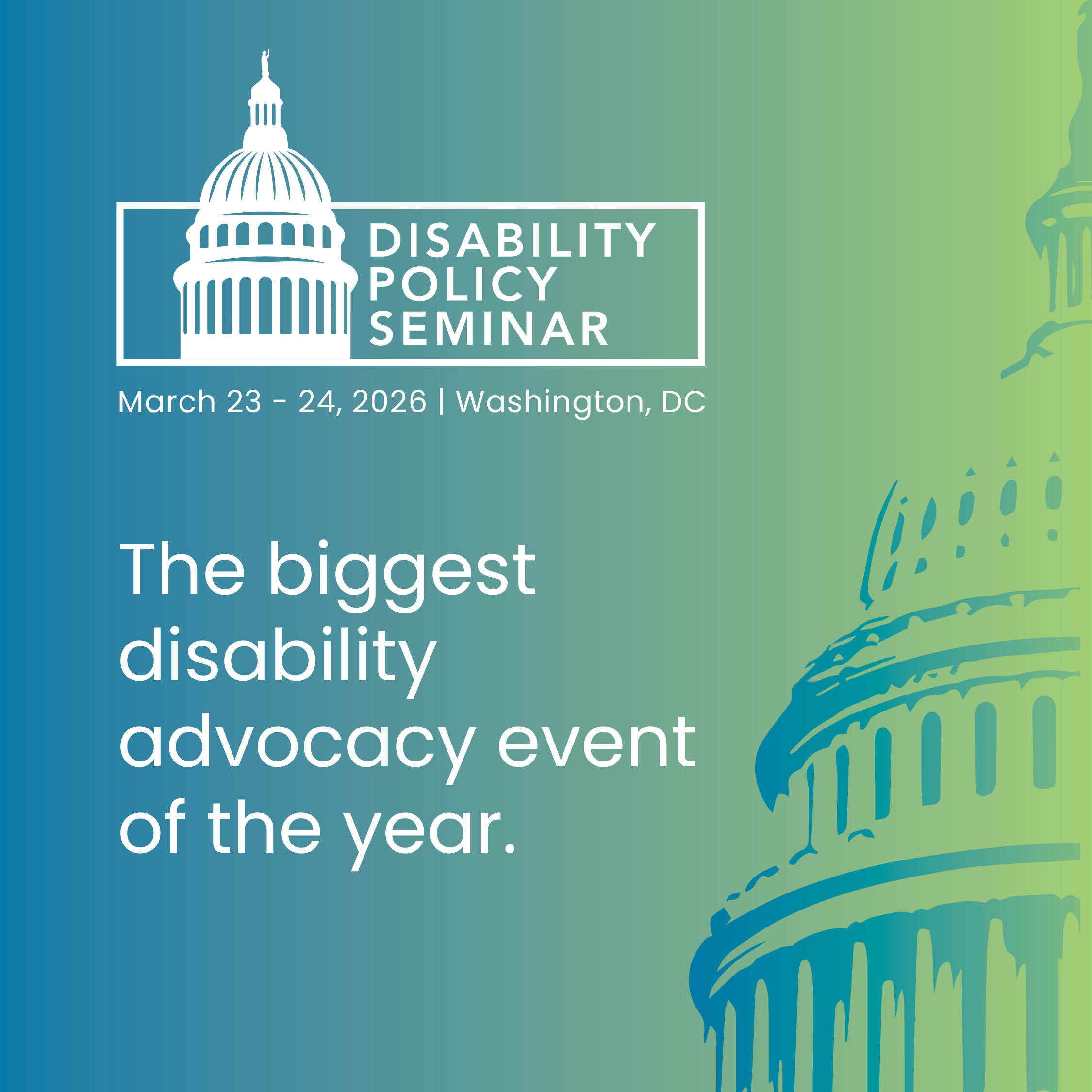
Registration is now open for the Disability Policy Seminar, taking place March 23–24 in Washington, DC. The Autism Society is proud to partner on this important event alongside The Arc of the United States, the American Association on Intellectual and Developmental Disabilities, the Association of University Centers on Disabilities, Caring Across Generations, Disability Belongs, the National Alliance for Direct Support Professionals, the National Down Syndrome Congress, United Cerebral Palsy, Self Advocates Becoming Empowered, and TASH.
This year’s seminar features a streamlined format: one day of in-depth policy training followed by a dedicated day on Capitol Hill, where participants will advocate directly with their Members of Congress on critical disability policy priorities.
Learn more and register at https://disabilitypolicyseminar.org/.
Fiscal Year 2026 Appropriations
Congress must still pass several appropriations bills before the January 30 deadline to fully fund the federal government for Fiscal Year (FY) 2026. To end the government shutdown in November, Congress enacted a continuing resolution (CR) that included three full-year appropriations bills covering Agriculture, the Legislative Branch, and Military Construction and Veterans Affairs programs. That legislation also extended funding for the rest of the federal government through January 30.
During the holiday recess, congressional leadership reached an agreement on top-line funding levels for the remaining nine appropriations bills and announced plans to move them in smaller legislative packages, known as minibuses.
The House and Senate recently passed one minibus, containing the Commerce–Justice–Science, Energy and Water Development, and Interior–Environment appropriations bills. The House just also passed the a minibus with the Financial Services and General Government and National Security, Department of State, and Related Programs Appropriations appropriations bills included. That package is now pending in the Senate.
The Defense, Transportation, Housing and Urban Development, and Homeland Security appropriations bills have yet to see any movement. In addition, the Labor, Health and Human Services, Education bill is held up by disagreements on language regarding protecting action against the Interagency Agreements.
Congress must advance these remaining bills, either individually, through additional minibuses, or through a long-term CR, before the January 30 deadline to avoid another lapse in government funding.
Department of Education
Meeting with Secretary McMahon
The Autism Society was proud to meet with Secretary of Education Linda McMahon alongside partners from The Arc, the National Center for Learning Disabilities, the Center for Learner Equity, the Council of Parent Attorneys and Advocates, the Council on Exceptional Children, and the National Down Syndrome Congress.
During the meeting, we raised targeted questions regarding the Office of Special Education Programs (OSEP), the Rehabilitation Services Administration (RSA), and the Office for Civil Rights (OCR). While many details remain unresolved, the discussion provided an important opportunity to underscore the essential role these offices play in safeguarding students’ civil rights and ensuring access to services, guidance, and, critically, meaningful oversight.
We look forward to continued engagement with the Secretary and her team and have followed up with a letter outlining our concerns and priorities, which can be found here:
https://c-c-d.org/fichiers/SecretaryMcMahon_FollowupLetter_1.9.2026.pdf
Department of Health and Human Services
Medicaid Community Engagement Requirements
Following the enactment of H.R. 1 in 2025, states will be required to implement so-called community engagement or work requirements for their Medicaid expansion populations by December 2026. States may request waivers to begin implementing these requirements earlier, and Arkansas has become the first state to seek such a waiver.
The Arc of the United States has released a new advocacy toolkit designed to help ensure that people with disabilities do not lose access to Medicaid because of new work reporting requirements included in the reconciliation law. The toolkit provides guidance on navigating exemptions, documentation, and advocacy strategies at the state level.
While the Department of Health and Human Services (HHS) is expected to issue a final rule by June to guide states on implementation, early engagement is critical. Advocates are encouraged to begin working with state officials now to shape exemption and exception processes and to put safeguards in place that protect people with disabilities from losing coverage or falling through administrative cracks.
Report on Protecting Family Caregivers
AARP has released an new report examining how states can ensure continuity of Medicaid coverage for family caregivers as community engagement requirements are implemented under H.R. 1. The paper highlights Medicaid’s critical role in supporting approximately 7.3 million family caregivers ages 18–64, enabling them to maintain their own health while providing care in home and community settings. Although H.R. 1 exempts family caregivers from community engagement requirements, the report underscores that state implementation choices will determine whether caregivers receive those protections. AARP outlines options available to states under the law, including thoughtful timelines, verification and reporting processes, and proactive outreach. The report also identifies existing data sources states can use to verify caregiver status and apply exemptions without unnecessary administrative burden. These recommendations aim to prevent coverage losses that could harm caregivers and weaken the broader long-term care system. This report serves as a crucial advocacy resource for engaging state leaders, offering concrete policy solutions advocates can use to help ensure family caregivers are protected as states move forward with implementation.
Share:
Related Posts


Featured
News
Uncategorized
Updates and News